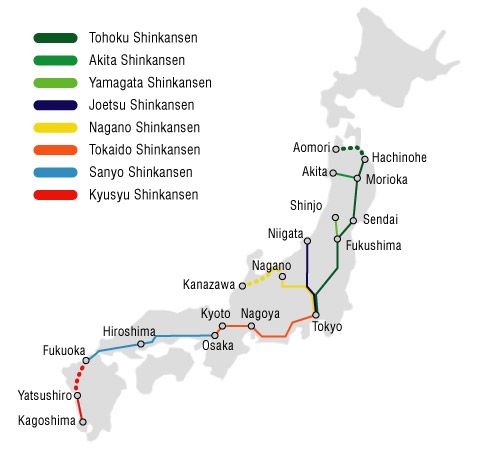
Japan, with its advanced technological prowess and commitment to sustainability, has an impressive network of high-speed rail systems, collectively known as Shinkansen, or simply, the bullet train. This revolutionary mode of transport has transformed the nation's landscape, offering unprecedented speeds, convenience, and efficiency to its passengers.
The history and evolution of the Shinkansen, starting from the Tokaido Shinkansen in 1964, are inconceivably intertwined with Japan's rapid economic growth and urban development. Today, Bullet Train routes span across the length and breadth of this island nation, connecting major cities and weaving through rural landscapes, all while providing an unparalleled travel experience.
Tokyo to Osaka: The Original Route
The Tokaido Shinkansen, which relieves the historic Tokyo-Osaka corridor, is the most renowned and busiest of all bullet train routes. This line has significantly reduced travel time between these two cities, once laboriously distant, to just over two hours.


The experience starts in Tokyo's immense JR Tokyo Station, a prime example of the blend of traditional Japanese architecture with modern functionality. The bullet train races through the Kanto and Kansai regions, offering varied landscapes from urban sprawl to verdant hills and coastal views, before terminating in Osaka's bustling Shinkowski Station. Aboard are passengers of diverse backgrounds, all bound by the shared excitement of the journey.
Tokaido Shinkansen Services
The Tokaido Shinkansen services comprise various train classes catering to different needs. At the pinnacle is the Nozomi, the fastest among them, running at speeds up to 320 km/h. Then, there's the Hikari, Kodama, and the newly introduced N700S series, each with its unique features and offerings.


The most premium among them, the Nozomi, not only offers speed but also an elevated travel experience with increased legroom, airport-style seating, and enhanced communal spaces. Each train class represents an opportunity for travelers to tailor their journey based on their priorities.
Stations Along the Route
The Tokaido Shinkansen touches down at several significant stations like Tokyo, Shinagawa, Kyoto, and Osaka. Each stop offers a glimpse into Japan's rich cultural heritage, with some stations linked to historic areas and traditional markets.
Take Shin-Osaka Station, for instance - adjacent to Universal Studios Japan and a stone's throw from the city's vibrant Dotonbori district, it's a testament to Japan's modern-yet-traditional ethos that permeates the entire Tokaido line.


Westward to Hiroshima and Kyushu
From Osaka, the San'yō Shinkansen extends further west towards Hiroshima and the island of Kyushu. This line opened in 1975 and has since evolved to include more modern train models, significantly increasing its reach and passenger volume. With comfort, cleanliness, and punctuality as its hallmarks, the bullet train still maintains its charm, attracting both locals and travelers alike.
The San'yō Shinkansen pauses at Japan's most historic sites, like Hiroshima's Peace Memorial Park and Museum, standing as a poignant reminder of the city's resilience. Kyoto's Architecture, Culture, and Tourism Bureau confirms that an average 4.6 million foreign visitors yearly visit Kyoto Station alone, highlighting the San'yō Shinkansen's role in tourism.
Express Trains and Mandatory Reservations
The San'yō Shinkansen operates express and rapid services, with trains being reserved seating-only. Passengers queue up to collect tickets at the station, and boarding is strictly by seat number, ensuring order and clarity in an otherwise bustling setting.


The sense of urgency and organization evident in Japanese railway culture translates to the San'yō Shinkansen, with each train promptly adhering to the scheduled departure time. It's this consistency and trust in the system that fosters a sense of ease among travelers.
The Expanding Network
The extension of this line to the southernmost island, Kyushu, opened up new avenues for global commerce and tourism. càrriages now navigate the picturesque coasts of the Bōsō Peninsula and the Kii Peninsula, culminating in the vibrant city of Kagoshima in southern Kyushu.
Here, the bullet train voyage culminates in the dramatic views of the active Sakurajima volcano, personifying Japan's surreal blend of modern marvels and natural phenomena.
Japan's bullet train routes reflect the nation's cultural fabric, embodying qualities like precision, elegance, and harmony. With future plans to expand these routes further, the Shinkansen stands as a continuation of Japan's path of progress, offering an unmatched travel experience that's both technological marvel and timeless charm.