Embarking on an adventurous off-road ride with your skateboard isn't just a thrill, it's now also an eco-friendly and technologically advanced experience, thanks to the emergence of off-road electric skateboards. These marvels of engineering combine the classic skateboarding spirit with modern electric power, opening up new terrain possibilities and redefining urban mobility.
Off-road electric skateboards, with their rugged design and powerful motors, are designed to tackle diverse landscapes, from uneven city pavements to rugged trails. They've evolved from being niche products to gaining traction among urban commuters, extreme sports enthusiasts, and eco-conscious adventurers.
Powering Off-Road Adventures: Electric Motor and Battery
At the heart of these powder-through-the-dirt machines lies a robust, high-torque electric motor. Paired with powerful batteries, these motors deliver consistent acceleration and hill-climbing prowess, ensuring you stay in command, whether at the skate park or on the winding mountain trails.


The battery technology has also seen significant advancements. Latest models come with lithium-ion or lithium polymer batteries that pack more energy into smaller sizes, keeping the skateboard lightweight and portable. These batteries are also intelligent, featuring built-in management systems that prevent overcharging or overheating, ensuring the skateboard's longevity.
Electric Motor Power
Motors powering off-road electric skateboards typically range from 1000W to 3000W or more, depending on the board's intended use. A higher wattage means more power to tackle steep inclines or push through heavy loads, but it also drains the battery faster. The sweet spot for most off-road enthusiasts lies around 2000W, offering a balance between power and range.

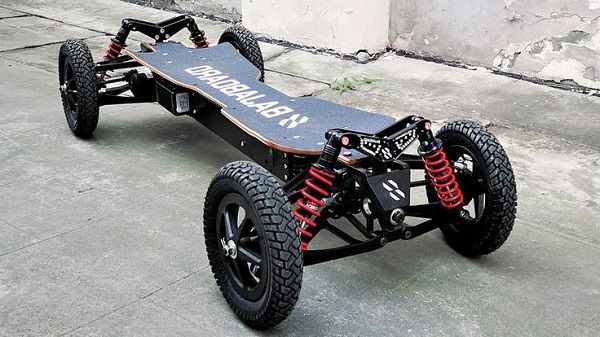

Some advanced models also feature dual or even quad motor configurations, providing extra power and stability. These motors are often controlled independently, offering precise handling and enabling features like drifting or power sliding.
Battery Capacity and Range
Battery capacity, measured in watt-hours (Wh), determines an off-road electric skateboard's range. For typical urban commutes, 7-10Ah batteries are sufficient. However, for extended off-road adventures, consider models with 12Ah or higher batteries, delivering an impressive range of up to 30 miles or more.
Battery percentage can be conveniently monitored through a mobile app or a built-in display, ensuring you're always aware of your power status. Many models also come with regenerative braking, which captures energy when you brake and uses it to recharge the battery, extending your riding time.


Conquering Off-Road Terrain: Tires, Suspension, and Deck Design
The key to taming rough terrain lies in an electric skateboard's tire type, suspension, and deck design. These elements combine to create a stable, comfortable, and safe riding experience.
Gone are the days of only pint-sized wheels for skateboards. Today, off-road electric skateboards roll on oversized pneumatic tires, providing the grip, stability, and shock absorption needed to traverse treacherous off-road trails. Some high-end models even feature air-filled, off-road tires typically found on mountain bikes, offering superior performance and traction.
Tire Sizes and Types
For most off-road terrains, 8-inch or larger off-road tires are ideal. These sizes strike a balance between roll speed and off-road capability. Larger tires, however, come with slower roll speeds and increased weight, affecting the skateboard's overall performance.


As for tire types, the most popular choices are solid rubber and air-filled tires. Solid tires, while more durable and puncture-proof, offer less shock absorption. Air-filled tires, on the other hand, provide better cushioning and traction but require regular maintenance to maintain ideal air pressure.
Suspension Systems
Innovative suspension systems, such as those found on the Evolve Carbon GT or the Latitude RunAbout, significantly enhance comfort and control on rough terrains. These systems typically consist of soft polymer bushings or a combination of metal and polymer components, aspirated shocks, or leaf spring suspensions.
Suspension setups impact handling dynamics, shock absorption, and overall stability. While more complex systems provide enhanced comfort andoff-road performance, they can also weigh more and be more challenging to maintain.
Deck Design: Size and Shape Matter
Deck design significantly influences an off-road electric skateboard's stability, maneuverability, and overall riding experience. Larger decks offer more stability and foot space, ideal for off-road terrains. Conversely, smaller decks are more maneuverable and better suited for tight spaces like urban environments.
Decks can also vary in shape, from drop-through (lower center of gravity) to cambered (for improved stability). For off-road use, drop-through decks or decks with a wider and lower center of gravity often provide superior stability.
Safety and User-Friendly Features
As off-road electric skateboards gain popularity, manufacturers are increasingly integrating user-friendly and safety-centric features, ensuring a memorable, worry-free riding experience.
Safety features include LED headlights and tail lights, allowing riders to see and be seen in low-visibility conditions. From waterproof casings to replaceable batteries, attention to durability and serviceability is also paramount.
Remote Control and App Integration
Reliable remote controls allow seamless adjustment of speed, acceleration, and power settings. Advanced models feature multiple riding modes, catering to both beginner and experienced riders. Usefully, some remote controls also integrate a display, providing real-time feedback on speed, battery level, and other ride-related metrics.
Bluetooth or Wi-Fi connectivity allows for smartphone integration, unlocking a host of additional features. Mobile apps can swap profiles, monitor performance, set-up board customization, and even track your rides. Moreover, 'Find My Board' features ensure you never lose your prized possession.
Safety Certifications and Material Standards
Reputable manufacturers ensure their products adhere to industry safety standards like UL 2272 (Underwriters Laboratories battery standards for lithium-ion batteries) or passive fire protection (PFP) certifications. These ensure that boards are less likely to catch fire or explode even in the event of a short circuit.
Additionally, many off-road electric skateboards prioritize reliable materials. From high-quality woods and carbon fiber for decks to durable, heat-resistant materials for motor and battery casings, these design choices help ensure longevity and maximized safety.
Off-road electric skateboards signal a bold new era in portable, eco-friendly transportation. Theyinvite us to redefine our relationship with the environment, embracing green mobility in its most adrenaline-pumped form. So gear up, hit the trail, and let the silent, sustainable revolution begin.